Shopee Malaysia NFR Policy Update: New Account Freeze Criteria from 21 December 2026
From 21 December 2026, Shopee Malaysia sellers who record a Non-Fulfillment Rate (NFR) of at least 20% and at least 10 non-fulfilled orders in each of two or more of the past eight weeks will receive 15 penalty points, resulting in an account freeze.
If your team handles Shopee orders, now is a good time to review your fulfillment performance, check your stock accuracy and address recurring cancellation issues.
Here is what you need to know, based on Shopee’s official announcement, updated on 10 November 2026.
What is changing?
Shopee’s penalty table shows weekly penalties ranging from 1 to 4 points, depending on the seller’s NFR and number of non-fulfilled orders that week. The new recurring NFR criterion carries 15 penalty points and an account freeze, as shown below.
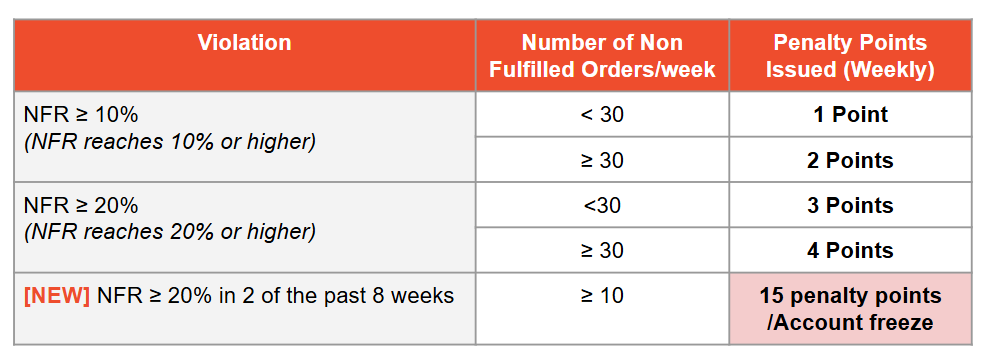
The new policy introduces a stricter penalty for sellers with persistently high NFR. It applies to all Shopee Malaysia sellers.
From 21 December 2026, sellers will receive 15 penalty points, resulting in an account freeze, if they meet both conditions below in at least two of the past eight weeks:
| Condition | Threshold in each qualifying week |
|---|---|
| Non-Fulfillment Rate | 20% or above |
| Number of non-fulfilled orders | At least 10 orders |
Both conditions must be met in the same week for that week to qualify. The two qualifying weeks do not need to be consecutive.
How does Shopee assess the penalty?
Shopee’s example shows why sellers need to monitor both their NFR percentage and the number of non-fulfilled orders.
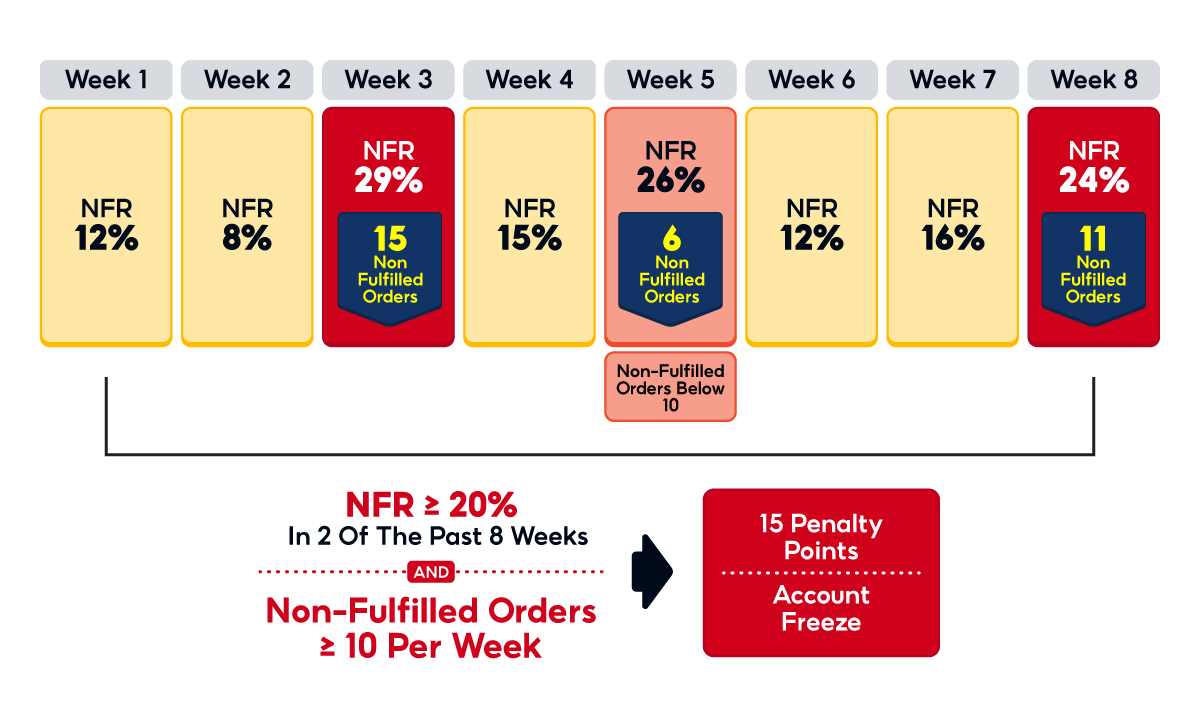
In this example, Weeks 3 and 8 qualify, so the seller meets the recurring high NFR criteria within the eight-week review period.
Shopee’s example then shows the following sequence:
- Week 8: Sellers have one week to appeal their high NFR for Week 8.
- Week 9: Shopee reviews Weeks 1 to 8. If at least two of those weeks each have an NFR of 20% or above and at least 10 non-fulfilled orders, Shopee issues 15 penalty points.
- Week 10: The account freeze takes effect.
This timeline follows the example provided in Shopee’s announcement.
Can sellers appeal?
Yes. Shopee states that sellers can appeal penalty points within 14 calendar days from the date the points are issued.
This penalty-point appeal window is separate from the one-week period to appeal Week 8’s high NFR shown in Shopee’s example above.
There is an important detail: sellers must submit separate appeals for the following:
- High NFR Penalty Point
- Recurring NFR Penalty Point
Appealing one does not automatically cover the other. If both penalties apply to your account, review and address each one separately.
What should sellers do now?
The following are Zetpy’s operational suggestions to help your team identify fulfillment problems earlier. They are not additional requirements announced by Shopee.
1. Review your performance every week
Track both your NFR and your number of non-fulfilled orders. Keep a record across the past eight weeks so your team can spot repeated issues.
If one week meets both thresholds, investigate the cause promptly. The policy looks at recurring performance across eight weeks.
2. Check that listed stock matches available stock
Review your best-selling products, low-stock items and stock shared across multiple sales channels.
If your physical stock and online quantities do not match, investigate and correct the difference before accepting more orders for those items.
3. Review outstanding orders daily
Make sure your team knows which orders need action and who is responsible for processing them. Flag stock shortages and other fulfillment problems early so they can be addressed promptly.
4. Find the reasons behind repeated non-fulfillment
Keep an internal record of affected orders and their causes. For example, your review may uncover stock discrepancies, unavailable products or missed processing steps.
Use those findings to fix the underlying workflow.
5. Keep track of appeal deadlines
If you believe a penalty needs review, prepare the relevant order records and supporting evidence promptly. Check which penalty you are appealing and whether a separate appeal is needed.
How Zetpy Inventory can support your stock management
For sellers managing several sales channels, keeping inventory organised is one practical step towards more reliable fulfillment.
Zetpy Inventory supports centralised inventory management and product, inventory and order synchronisation across connected channels, including Shopee. This can help your team reduce manual stock updates and manage shared inventory more consistently.
Continue to check your NFR, penalty notices and appeal deadlines directly in Shopee.
For the full policy details, read Shopee’s official announcement.
Want to see how Zetpy Inventory can support your business? Book a demo.